The Outshift Brief
The Outshift Brief transforms technical video sessions from Outshift by Cisco into concise, readable, and scannable newspaper-style articles. Our AI-driven editorial process distills hours of complex technical discussions into actionable insights for busy professionals. Readers gain quick access to key findings and expert recommendations without watching entire video presentations.
An editorial discovery layer — not a blog
This publication differs from a standard blog in its fundamental purpose: it is an editorial discovery layer for large video archives, not a platform for publishing standalone text articles. Where a blog is a chronological list of posts, this system converts scattered recordings into searchable, timestamped, article-led knowledge assets — turning a raw video portal into a structured newsroom.
Deep integration with video assets
Every article is an editorial summary of a long-form recording, not a standalone piece. Timestamp deep links let readers jump to the exact moment in the original video where each claim was made — turning a 45-minute session into a navigable reference, one click at a time.
Discovery over chronology
A standard blog relies on a reverse-chronological feed. This model uses a newsroom-style homepage with topical navigation, lead stories, and related-content surfaces to reduce time-to-relevance when navigating hundreds of hours of accumulated technical content.
Content capex recovery, not content creation
A blog creates net-new content. This approach recovers value from content an organisation has already funded. Sessions recorded at Cisco Live, KubeCon, or internal engineering summits — watched once live, then quietly forgotten — gain findability, shelf life, and ongoing utility.
Enterprise-ready foundations
The structured taxonomy, metadata, and content architecture this system establishes can support enterprise integration — search analytics, audience segmentation, and access controls — as the publication grows. The foundation is designed to accommodate those layers without rebuilding from scratch.
Conversion and attribution, not just readership
Article pages act as decision layers — structured with metadata and SEO so that recorded expertise becomes indexable, shareable, and attributable to specific business outcomes: developer adoption, partner enablement, support deflection. The goal is not to be read; it is to drive action.
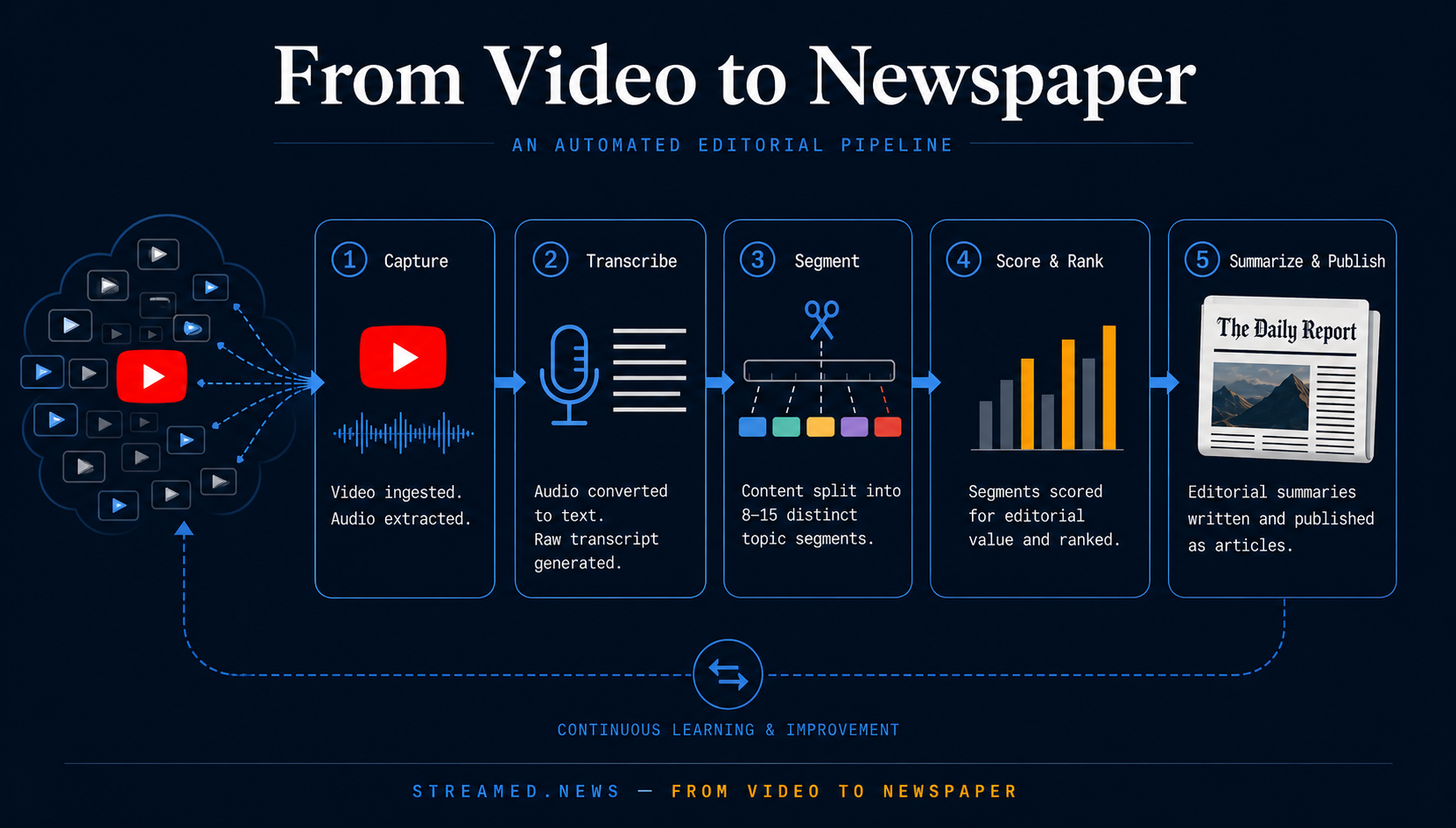
The underlying platform (Ghost) could run a perfectly ordinary blog. What makes this different is not the technology — it is the process. A pipeline with the speed and precision to transform any video archive into a polished editorial publication, continuously, at a cost no human newsroom could match.
The transformation
Every article on this site began as a video. A purpose-built AI pipeline watches each session, identifying crucial moments such as a new architectural pattern, a specific configuration step, or a deep dive into an AI security finding. This system then synthesizes the presented information into clear, succinct articles. Each piece features a compelling headline that states the core finding, two tight paragraphs of context and explanation, and a quote when one earns its place for maximum impact. Every claim is rigorously tied to its exact timestamp in the original video, ensuring full traceability and allowing readers to dive deeper. The result is original prose that delivers real editorial value.
The result is a publication that runs on Outshift by Cisco's content but reads like a technology newspaper — produced at a speed and scale no human editorial team could match. Engineers can scan headlines over breakfast. Architects can search for a specific topic. Managers can stay current without sitting through a 45-minute session to find the three minutes that matter to them. One click, and you are at the source.
Why It Works: Three Principles from Print
For centuries, newspapers solved a problem that video still hasn't: how to let readers quickly find what matters to them. We borrowed three of their best ideas.
The Newspaper Scanning Model
Humans have refined a media consumption habit over centuries: scan the headline, read the deck, skim the opening line — and decide in three seconds whether a story is worth your time. This instinct is how readers triage thousands of potential articles before breakfast. A well-structured editorial activates that same muscle, letting a reader process ten sessions in the time it takes to press play once on a video.
Hyperlinks to Exact Moments
Every article links not to "the session" but to the precise timestamp where each idea was expressed. Not "watch the 47-minute keynote" — but "jump to 23:14 where the engineer demonstrates the configuration." These deep links transform a library of recordings into an instantly navigable reference. When something matters, one click takes you exactly there — no scrubbing, no guessing, no wasted time.
Sessions Become Stories
A conference session is an excellent source of knowledge — but it was designed for live attendance, not asynchronous reading. Editorialising restructures each session into a proper article: the most important insights surfaced first, jargon explained for the uninitiated, and context added where the speaker assumed prior knowledge. The result is easier to read, easier to remember, and easier to share — while every claim remains traceable through precise, clickable timestamps.
Editorial beats
The publication covers five areas where Outshift by Cisco is doing its most active work.
AI Agents and LLMs
This beat explores the latest advancements in AI agents and large language models (LLMs), focusing on their application in areas like automated incident management, developer provisioning, and streamlining engineering workflows. It covers foundational concepts, architectural patterns, and practical implementations, including discussions on new models like LightLLM and Anthropic's Model Context Protocol (MCP).
AI Security and Compliance
This section delves into the critical security challenges and compliance considerations surrounding AI agents and LLMs. Topics include prompt injection attacks, supply chain vulnerabilities in AI ecosystems, post-quantum cryptography, and frameworks like Cisco Defense's CodeGuard and Tetragon for real-time threat mitigation and AI compliance within multi-agent systems.
Network Automation
Dedicated to the principles and practices of network automation, this beat features content on CI/CD pipelines for network configuration, the use of tools like Ansible and Terraform for declarative infrastructure management, and advanced topics such as network device simulation, API integration with Catalyst Center, and AI-driven syslog analysis.
DevOps and Platform Engineering
This beat covers best practices and innovative approaches in DevOps and platform engineering. Content includes strategies for robust software testing, establishing ephemeral development environments, automated release processes, and how AI is enhancing aspects like root cause analysis in development pipelines and streamlining developer productivity.
Observability and Troubleshooting
This section focuses on tools, techniques, and AI-driven solutions for monitoring system performance and diagnosing issues. It features discussions on time-series foundational models for forecasting, AI agents for automated troubleshooting in Kubernetes and network operations, and advanced data visualization with Grafana, InfluxDB, and GitHub Copilot for real-time and historical data analysis.
About Outshift by Cisco
Outshift by Cisco is an incubation arm of Cisco dedicated to fostering innovation and exploring emerging technologies. It produces a wide range of video content, from technical deep dives to expert interviews, covering advanced topics in AI, networking, and software development, which serves as the source material for this publication.
The Outshift Brief is an independent editorial project and is not an official communication channel of Outshift by Cisco.