Original source: Outshift by Cisco
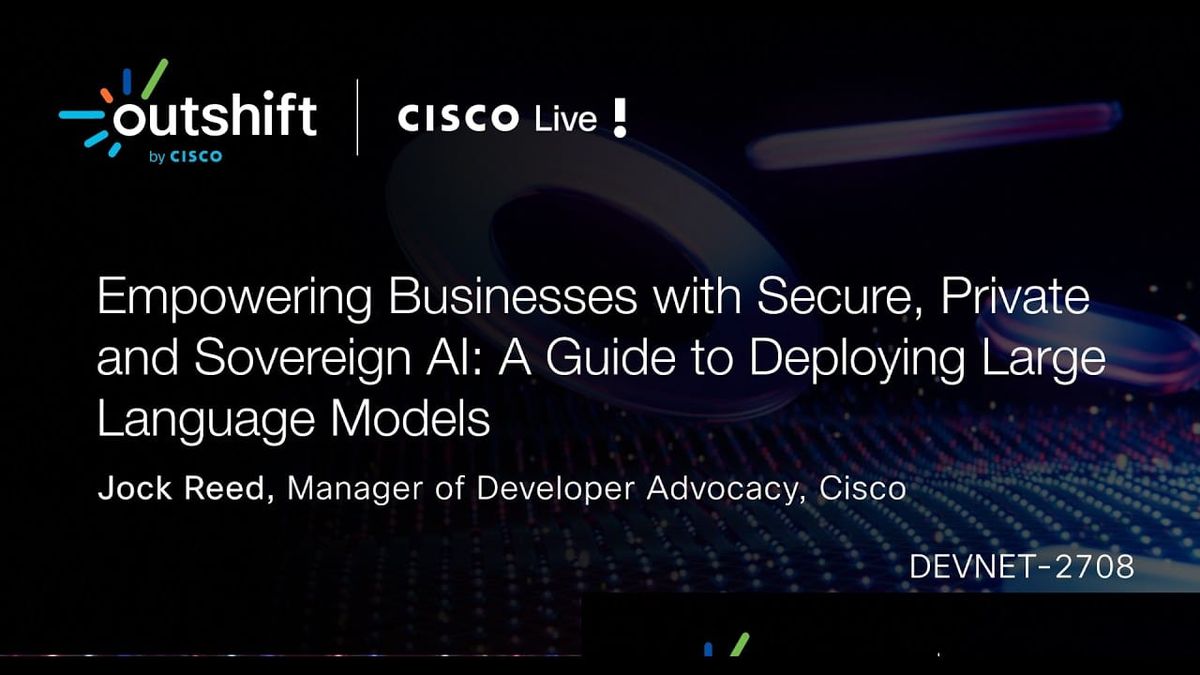
This video from Outshift by Cisco covered a lot of ground. 6 segments stood out as worth your time. Everything below links directly to the timestamp in the original video.
As AI becomes more integral to business operations, understanding these challenges is crucial for developing robust, ethical, and secure AI strategies. The choice between cloud and on-premise solutions carries significant implications for data governance and operational autonomy.
Data Privacy and Transparency Hinder AI Adoption for Businesses
Organizations face significant hurdles in adopting artificial intelligence, particularly concerning data privacy and the lack of transparency in cloud-based large language models (LLMs). A notable case involves a Swedish bank that could not use Google Gemini due to U.S. laws allowing access to data held by American companies, even if stored in Europe. This highlights the critical need for businesses to understand where their data resides and who can access it, prompting some to consider deploying their own LLMs for greater control.
Beyond privacy, integration complexities, scalability challenges for on-premise deployments, and operational costs are major concerns. Ethical considerations, such as biases embedded in pre-trained models, also influence LLM selection. The opaque nature of commercial LLMs, whose internal workings are not fully disclosed, further pushes some companies towards self-hosting to ensure compliance and maintain oversight over their AI infrastructure.
"Where your data lives, how you're able to access that...it's pretty common for LLMs that they have vulnerabilities too. So you're adding another vector for people to be able to get and access your data."
LLMs Boost Customer Support, Internal Communication, and Content Creation
Large Language Models (LLMs) are transforming various customer-facing and internal business functions, from enhancing customer support to streamlining content creation. In customer service, LLMs can provide initial, human-like interactions to efficiently route inquiries, though it is crucial to maintain a 'human-in-the-loop' option to prevent customer frustration. Internally, LLMs excel at summarizing meetings, generating task lists from discussions, and refining email communications, with platforms like Webex already integrating AI summaries.
Beyond communication, LLMs significantly aid content creation for marketing by helping non-specialist teams produce polished, professional materials. They also provide rapid data analysis from diverse sources like spreadsheets and documents, offering fresh insights that human teams might overlook. These capabilities collectively optimize business processes, allowing organizations to operate more efficiently and innovate faster, while emphasizing the importance of human oversight to ensure accuracy and relevance.
"When you do have a way to keep a human in the loop for that, that's actually very useful."
LLMs Lack Intrinsic Memory, Rely on Client for Conversational Context
Large Language Models (LLMs) are inherently stateless, meaning they do not retain memory of past interactions within a conversation. Instead, client applications must bundle all previous messages and responses into each new request sent to the LLM to provide the necessary context. This process, demonstrated using Open Web UI and Postman, illustrates that the LLM itself is an 'inference-only' component, devoid of short-term memory.
The analogy to the movie "Memento," where the protagonist constantly takes notes to overcome short-term memory loss, effectively explains this technical constraint. Without explicit context provided by the client, the LLM cannot understand previous turns in a conversation, asking for clarification on previously discussed topics. This fundamental architecture highlights that the perception of LLMs having conversational memory is an illusion created by the client-side management of context.
"The LLM on the back end it's just inference only... Unless they have the notes, unless you've given them the context, they have no idea what's going on."
LightLLM Simplifies LLM Integration with Unified API and Management Tools
LightLLM emerges as a valuable tool for businesses seeking to streamline the integration and management of diverse Large Language Models (LLMs). It provides a unified, OpenAI-like RESTful API endpoint that allows applications to interact seamlessly with various LLM providers, whether on-premise or cloud-based, without requiring code changes. This standardization simplifies switching between models like ChatGPT and Claude, improving flexibility for developers.
Beyond API unification, LightLLM offers critical operational features such as load balancing and failover capabilities, ensuring continuous service even if an LLM becomes unavailable. It also provides insights into spending by tracking usage down to tokens or time, and enables robust API key authentication with team-specific access controls. This allows organizations to manage access to different LLMs based on departmental needs, optimizing costs and security.
"It gives you a front end that looks... a restful API end to where it's just like OpenAI... any applications that you were using that work with OpenAI or ChatGPT will work with Claude in the same way and you don't have to change a darn thing."
LLMs Accelerate Engineering Workflows, From Code Generation to Debugging
Large Language Models (LLMs) are significantly enhancing engineering workflows by accelerating various development tasks. From an engineering perspective, LLMs can rapidly scaffold code, create templates for automation tools like Ansible and Terraform, and assist in refactoring existing code, dramatically speeding up project initiation. They also prove highly effective in debugging code, identifying potential Common Vulnerabilities and Exposures (CVEs), and suggesting fixes, even if engineers ultimately choose alternative solutions.
A particularly favored application is automated documentation generation, a task often disliked by engineers. LLMs can explain complex code, even code written years ago by the same engineer, enabling clearer understanding and smoother project handoffs. By allowing natural language interaction with code and automating these time-consuming processes, LLMs empower engineering teams to move faster, write more efficient code, and deploy configurations with greater agility.
"My third one is actually my favorite because if you're like me, most engineers don't like writing docs."
LLM Servers Operate as Stateless, Inference-Only Components
The server-side architecture of Large Language Models (LLMs) reveals them to be fundamentally stateless and inference-only components. Similar to any other application, the core LLM program requires CPU, RAM, and typically a GPU for operation, but it does not retain any memory of past conversations or handle conversational context. This means that each request sent to an LLM server is processed independently, without knowledge of preceding interactions.
The crucial implication is that any conversational history or context must be managed externally by the client application before being sent to the LLM. While LLMs produce human-like responses, their server-side deployment is conceptually similar to running any other application, albeit with specific hardware demands like GPUs. This stateless design is a key architectural characteristic that influences how conversational AI applications are built and managed.
"It is inference only for this...it is stateless on this side of things...it does not handle any of the context of the conversation that you are having with the LLM."
Also mentioned in this video
- The presenter clarifies that the client-side or front-end application acts as… (19:02)
- Ollama and vLLM as recommended tools for building and running LLMs, noting… (21:35)
- Deployment tools, emphasizing that traditional DevOps tools like Ansible,… (29:02)
- Another tool that routes complex and simple requests to different models based… (31:45)
Summarised from Outshift by Cisco · 45:48. All credit belongs to the original creators. Streamed.News summarises publicly available video content.